Playsure Network: Experiments Towards Resistance
On the Becoming of 135 Home Studio and our first exhibition in October 2025 at Lewisham Arthouse
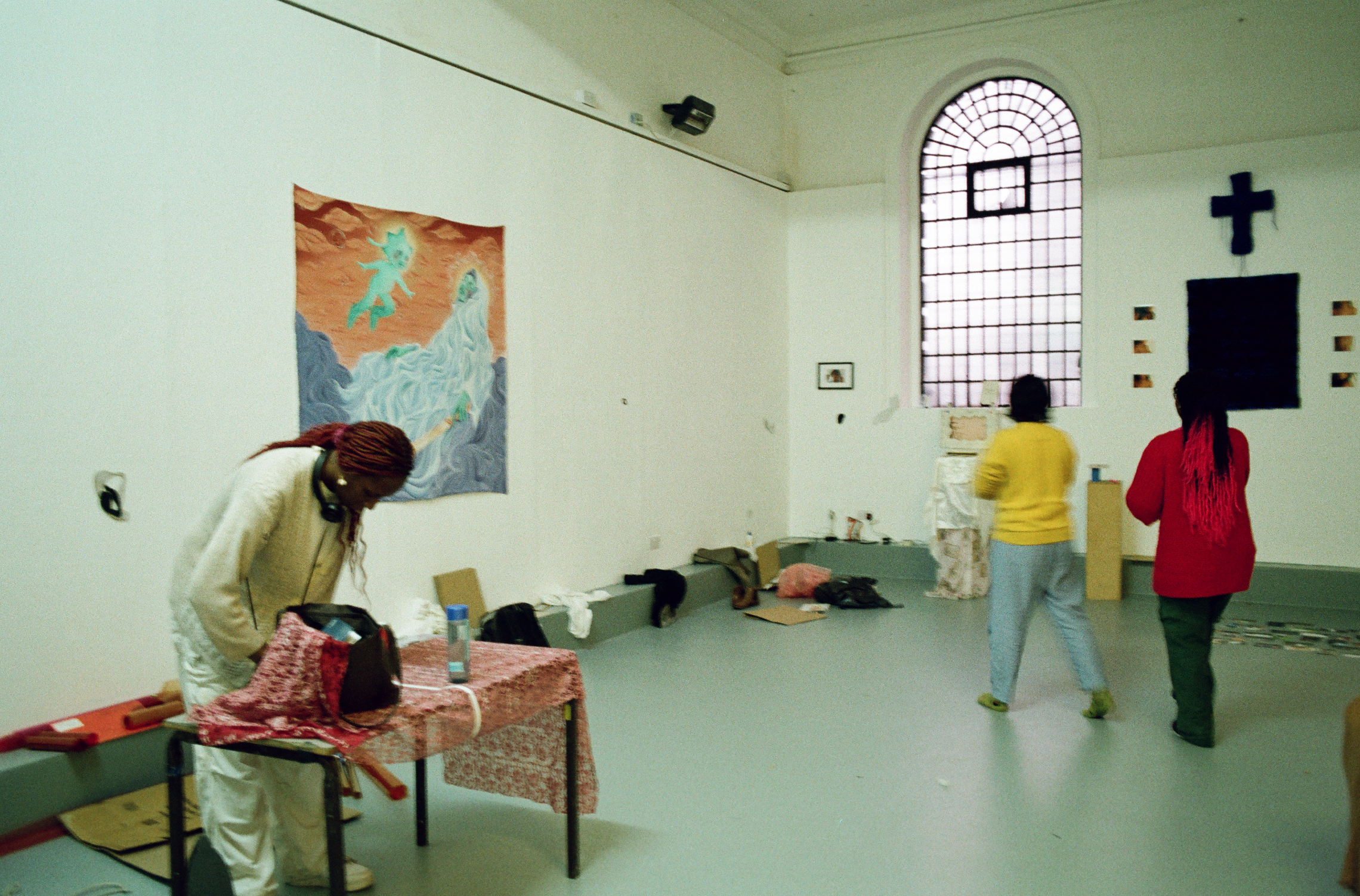
Playsure Network exhibition install, 35mm film, 2025
Abstract
How do we build the conditions for collective freedom when crisis has become an ordinary feature of everyday life? This essay reflects on the development of 135 Home Studio, a nomadic platform for Black queer creative practices, and its first exhibition, Playsure Network: Experiments Towards Resistance. Drawing on Black feminist standpoint theory, personal experience and collective curatorial practice, it considers how overlapping social, political and economic crises shape the possibilities available to marginalised artists. It proposes playsure—an amalgamation of play, care and pleasure—as both a curatorial method and a means of sustaining resistance. Through mentoring, collective critique, resource-sharing and the cultivation of intentional relationships, Home Studio experiments with ways of making art and community that centre trust, presence and collective survival.
On Becoming 135 Home Studio
Welcome. In this essay, we will consider the becoming of 135 Home Studio and its first exhibition, Playsure Network: Experiments Towards Resistance. We will move between personal experience, political observation and curatorial practice to explore how a space for Black queer creative development might emerge within conditions of sustained uncertainty. This is an ongoing inquiry rather than a finished theory; some of its conclusions remain provisional, and its contradictions are part of what makes the work necessary.
135 Home Studio began as an idea in my flatshare where my partner and I shared two rooms and began to use one room as a makeshift studio (135 was the beginning of our address). Then in February 2023, while I was working as a Programme Assistant at QUEERCIRCLE I proposed an expanded version as an independent experimental project that would bring together workshops, talks and create space for and by queer, trans and people of colour (QTPOC) artists. The intention was to create opportunities for artistic development, empowerment and visibility, while building a community in which our practices could be nurtured beyond the limitations of existing cultural infrastructures. They said yes and we ran there for 6 months.
Our first workshop, with Ajamu X, helped establish a foundation for the project. Mentoring and collective learning became central to our approach, creating opportunities for artists to develop their work alongside others who understood something of their circumstances. After our ‘residency’ there we were offered space for 12 months by Lewisham Arthouse and what began as a series of activities has since become a nomadic platform, collaborating with institutions like 198 Contemporary Art and Learning and UAL, ect in London and elsewhere to deliver programming, exhibitions and residencies while working towards the possibility of a permanent home.
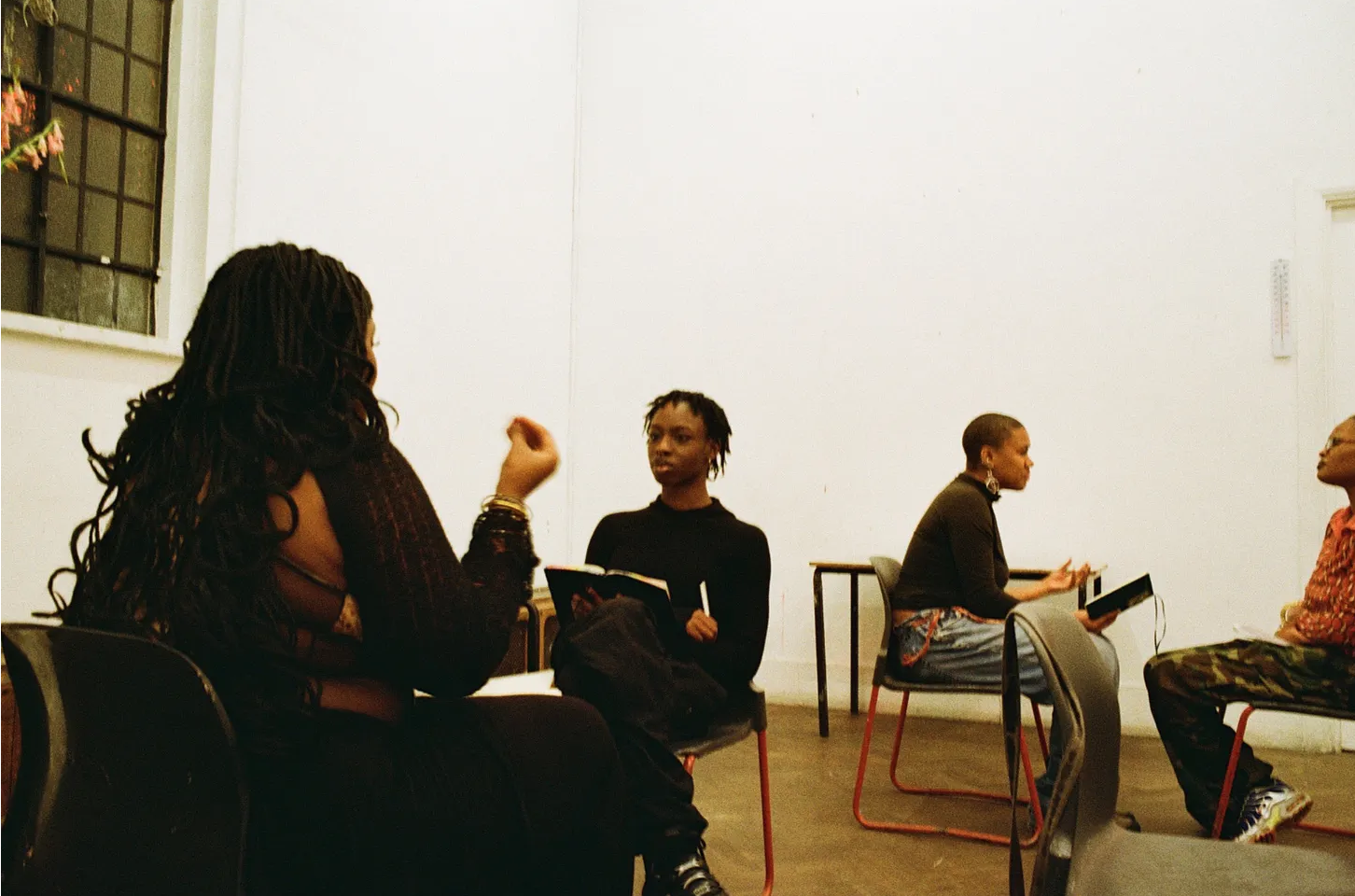
Trust building workshop / CRIT in Lewisham ArtHouse, 35mm film, 2025
Home Studio is both a personal practice and an institutional experiment. It asks what a cultural space might look like if its infrastructure were built around the needs of its community rather than requiring that community to adapt to the demands of the institution. It also asks how we might create something enduring without reproducing the exclusions, hierarchies and precarities that shape the cultural sector.
To understand why this work matters, I turn to Black feminist standpoint theory: a framework first coined by Patricia Hill Collins that recognises lived experience as a source of knowledge from which dominant accounts of society can be challenged. My experiences of racism, economic insecurity and deteriorating mental health are not simply background to the development of 135 Home Studio. They inform its methods, priorities and understanding of what artistic practice requires to survive. This is not to suggest that any individual experience can represent an entire community, but rather that knowledge produced from marginalised positions can reveal conditions that dominant institutions often overlook.
Photo taken during a group photo walk event, 35mm film (Lomography LomoChrome Turquoise), 2024
Living Through Conjunctural Crisis
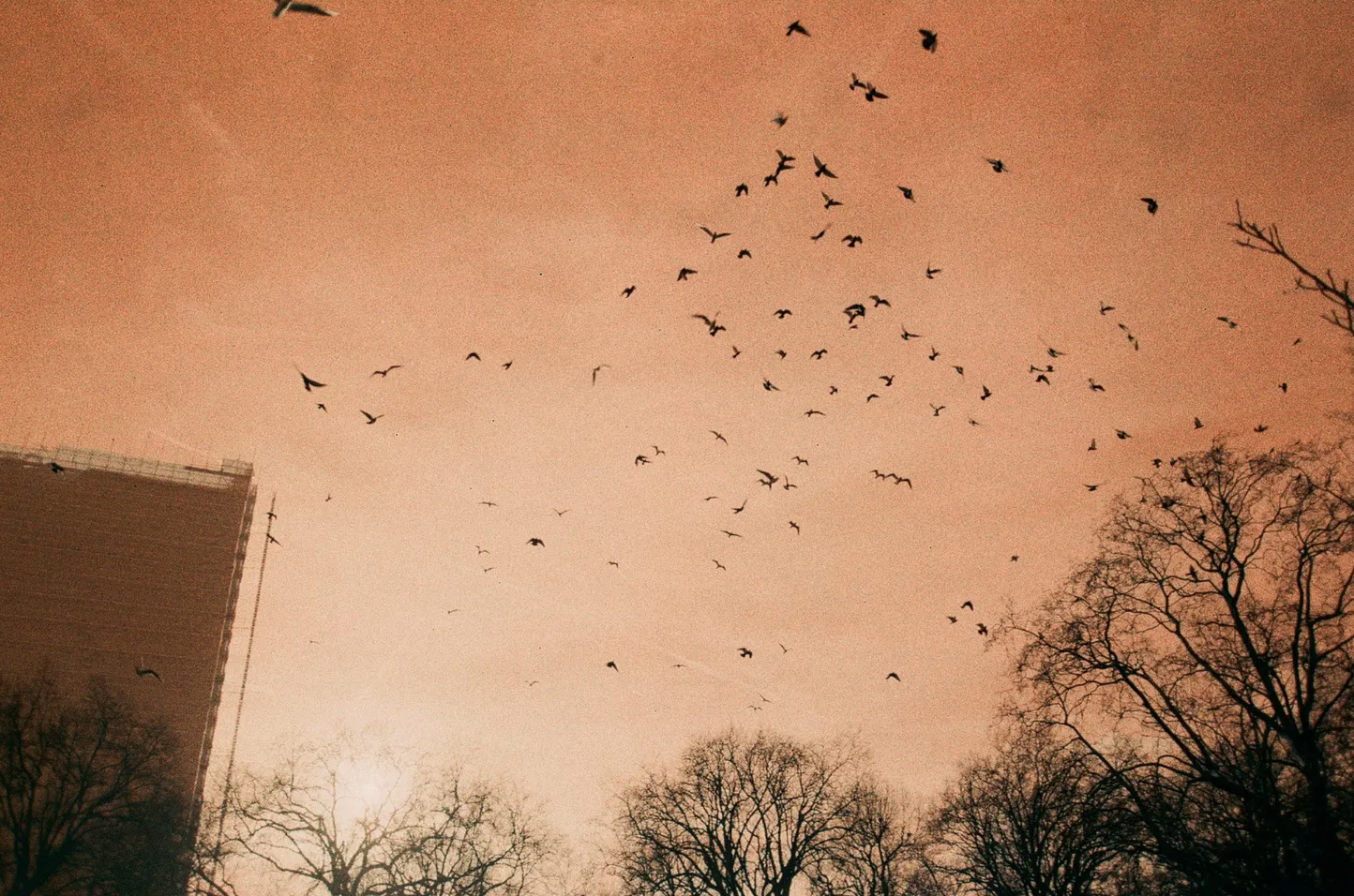
Photo taken during a group photo walk event, 35mm film (Lomography LomoChrome Turquoise), 2024
Stuart Hall’s understanding of the conjunctural crisis offers a useful way to consider the circumstances in which 135 Home Studio emerged. A conjuncture describes a historical moment in which different social, political, economic and ideological contradictions converge, producing a particular set of conditions and possibilities. Crisis, in this sense, is not a single event with a singular cause. It is the coming together of multiple pressures whose eventual resolution remains uncertain.
My experience of this conjuncture was deeply personal. Before establishing 135 Home Studio, I experienced a deep burnout. I was a highly skilled worker, carrying educational debt and working alongside colleagues who had attended elite universities, yet earning very little. At one point, I found myself weighing the costs of paying rent against the unbearable weight of continuing to live as I was. These experiences exposed the distance between the promise of professional achievement and the material conditions required to sustain a life.
London’s cost of living, racism and the pressures of precarious employment converged in ways that make survival feel increasingly difficult. It was through community that I continued. I began making Messy, a collection of collages and imperfectly edited poems, as a way of returning to myself. In the company of Black artists and curators at Studio Voltaire. With the support of artists like Sola Olulade, Danielle Braithwaite Shirley, Bamidele Awoyemi and Chloe Filani as well as curator, gallerist and founder of Black Blossoms, Bolanle Tajudeen, I encountered relationships and creative possibilities that helped me imagine another way of working.
This experience also sharpened my awareness of unequal access to space, how it is to be awarded a studio and run it. Having a gallery and studio of my own had been a dream since college, but the advice to simply “just start” from more privileged players1 in the art world overlooked the material barriers involved. I had neither the money for a studio nor the resources to establish a gallery. I was working part-time at Gail’s while trying to maintain an artistic practice. The problem was not a lack of ambition or ideas; it was a lack of the conditions through which those ideas could become possible. However, the friends I made showed me that our greatest resources were each other, as they now only allowed me to make work in their spaces but introduced me to the Black British art world and history.
When I began working at QUEERCIRCLE, I noticed that rooms could remain empty while artists lacked places to gather, make work and develop their practices. What if an empty room could become something other than a studio or exhibition space? What if it could become a place to work, unwind, meet others and think together?
135 Home Studio emerged from this question. It was a modest intervention into a much larger problem: the uneven distribution of resources, space and security within the cultural sector. It also offered a way to respond to crises without waiting for the circumstances that produced it to change.
The pressures surrounding us extend far beyond the art world. Genocide, fascism, xenophobia, transphobia, homophobia, climate crisis, widening class divisions, financialisation and the psychological pressures of neoliberal life do not operate independently. They overlap and intensify one another, shaping who can participate in public life, who has access to cultural resources and who is left to manage the consequences alone.
At the same time, the accumulation of crises can make meaningful political action difficult to organise. Attending The World Transformed conference in Manchester brought this contradiction into focus. Across a packed programme of simultaneous events, participants had to choose between competing issues, often splitting into groups to cover more ground. In political discussions, I observed how easily conversations could become repetitive, how disagreements could harden into divisions, and how competing priorities could obstruct the development of shared strategies.
The experience raised questions about the relationship between political conviction and collective organisation. If every struggle is presented as the most urgent, how do we build the relationships and structures needed to address them together? If our movements reproduce the fragmentation they seek to overcome, how do we develop a shared capacity to act?
A net with holes catches no fish. The problem is not that our struggles are unrelated, but that their connections are not always adequately cultivated. Unity cannot simply be declared; it must be practised. It requires trust, accountability, coordination and an understanding that collective liberation cannot be secured through isolated victories alone.
Healing Through Connection
135 Home Studio begins with the home: not simply as a domestic structure, but as a site where safety, trauma, belonging and the possibilities of being together are negotiated. For Black and global majority queer artists, whose lives may be shaped by overlapping experiences of exclusion, displacement and precarity, the question of where we can feel at home is also a question of where we can think, create and exist freely without code switching or continually defending our right to be there.
Our workshops are curated with this in mind. We ask what it takes to build a space in which people feel witnessed, and we develop shared principles for how we want to work together. From this foundation, we make and critique art, with the intention of carrying transformative possibilities into public life.
This inner work is not separate from the artwork. The seemingly ordinary moments of getting to know an artist, curator or researcher can establish the conditions for more meaningful collaboration. Trust develops through repeated encounters; accountability becomes possible through relationships; and critique becomes more productive when people feel sufficiently supported to take creative risks.
These relationships must also be understood materially. During the programme, one artist faced homelessness. Home Studio offered space and resources, and their artistic contribution eventually became a card game designed to help people get to know one another more deeply. Friendship is not a solution to the housing crisis, nor can a community platform replace the responsibility of the state. Yet this experience demonstrated how relationships can enable practical forms of support while generating new artistic possibilities.
When institutions and governments fail to meet people’s needs, communities frequently absorb the consequences through informal and often unpaid care. Such labour is essential, but it can also become exhausting, particularly when responsibility falls disproportionately on those already experiencing marginalisation. 135 Home Studio must therefore confront a difficult question: how can we practise care without normalising the conditions that make care so necessary?
The answer cannot be to romanticise resilience or assume that marginalised communities should endlessly compensate for institutional neglect. Community support and institutional responsibility must exist together. Sustainable practice requires resources, safeguarding, fair payment, conflict resolution and an honest recognition of the limits of what individuals can give.
Our understanding of a healthy artistic culture must therefore include those who are neurodivergent, disabled or survivors of harm, as well as the complexities of interpersonal conflict, power dynamics, fatigue and accountability. A commitment to community does not mean that disagreement disappears. It means developing ways to address harm without abandoning the possibility of collective life.
Playsure Networks exhibition install, 35mm, 2025
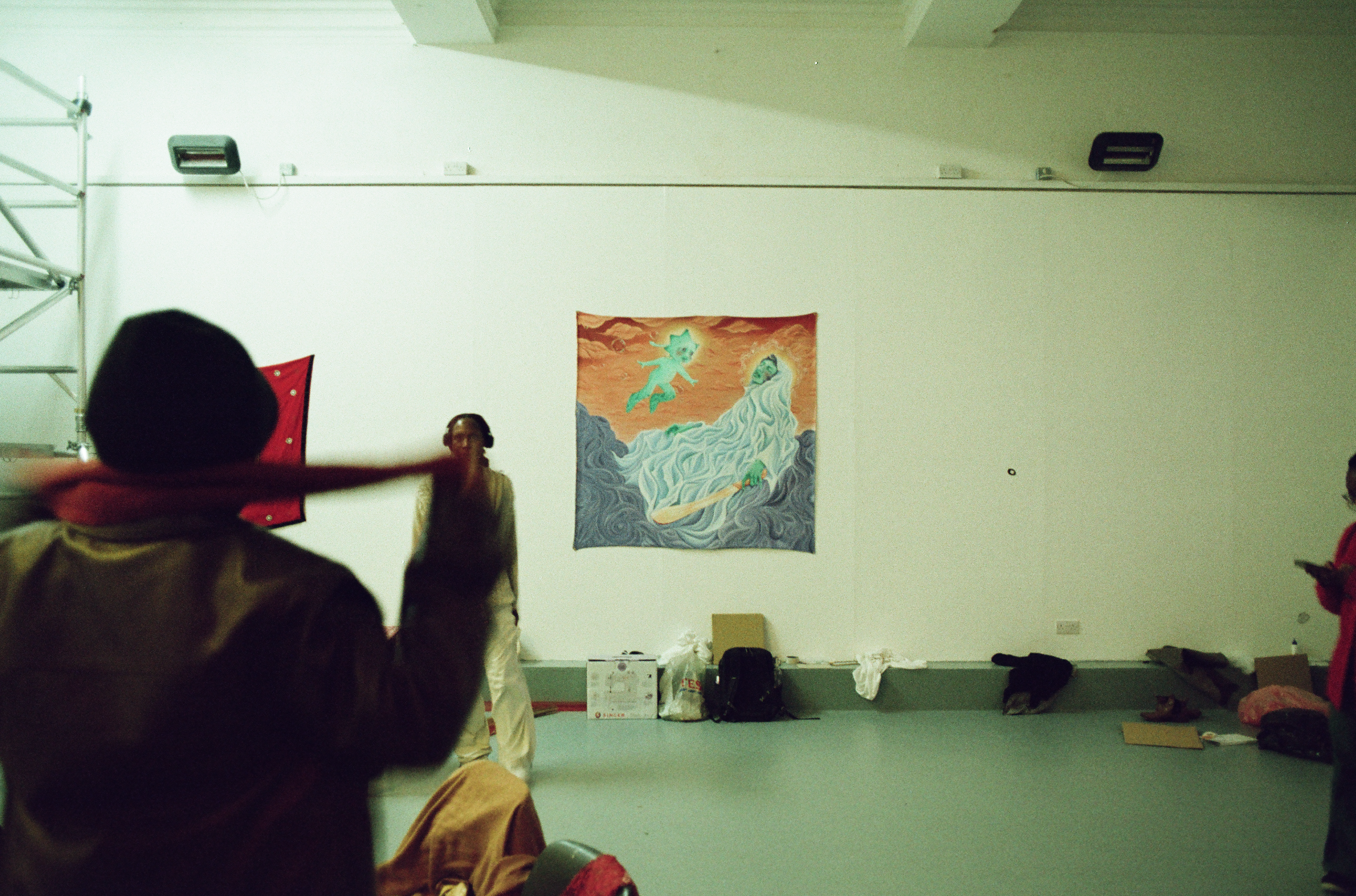
Playsure Networks exhibition install, 35mm, 2025
Playsure as a Method of Resistance
Over the course of a year, 135 Home Studio held monthly critiques and developmental workshops with the QTPOC public before bringing together a cohort of thirteen artists, selected through an open call, to develop our first exhibition in partnership with Lewisham Arthouse.
Together, we developed the idea of playsure: an amalgamation of play, care and pleasure as a method of resistance.
Playsure begins with a proposition: connection is not merely a reward for political struggle but one of the conditions that makes struggle sustainable. Play offers a way to encounter one another without every interaction being governed by productivity, conflict or the demand to produce an immediate outcome. Pleasure makes room for curiosity, experimentation and the possibility of being surprised by someone else. Care allows these encounters to develop without treating people as disposable resources.
Together, these practices offer an alternative to the exhaustion that can accompany both capitalist work cultures and political organising. They invite us to consider what might happen if our methods of resistance were designed not only around what we oppose, but also around the kinds of lives and relationships we want to make possible.
This does not mean withdrawing from the seriousness of the present moment. Rather, it asks whether seriousness must always take a militant or confrontational form. The strategies that emerged from earlier histories of Black radical resistance were shaped by the particular violences of their time. Today, state power and authoritarian tendencies operate alongside mass surveillance, digital harassment, algorithmic polarisation and forms of psychological manipulation. The conditions have changed, even where the underlying inequalities persist.
If the mechanisms of control are changing, our tactics must remain responsive. Resistance requires more than repeating inherited forms; it requires understanding the present and experimenting with ways to intervene in it.
For younger generations, whose political engagement may be shaped by economic insecurity, digital environments and the normalisation of crisis, collective action can feel distant from everyday life. Playsure proposes that the experience of making and being with others can offer a point of entry. In-person encounters, shared creative work and the slow development of relationships can make participation feel meaningful, accessible and rewarding.
The aim is not to turn activism into entertainment or to suggest that play alone can dismantle oppressive structures. It is to recognise that political participation must also be sustained through practices that allow people to recover, connect and imagine. Activism can be pleasurable without losing its political purpose. Joy can be a resource rather than a distraction.
Practising Another Way
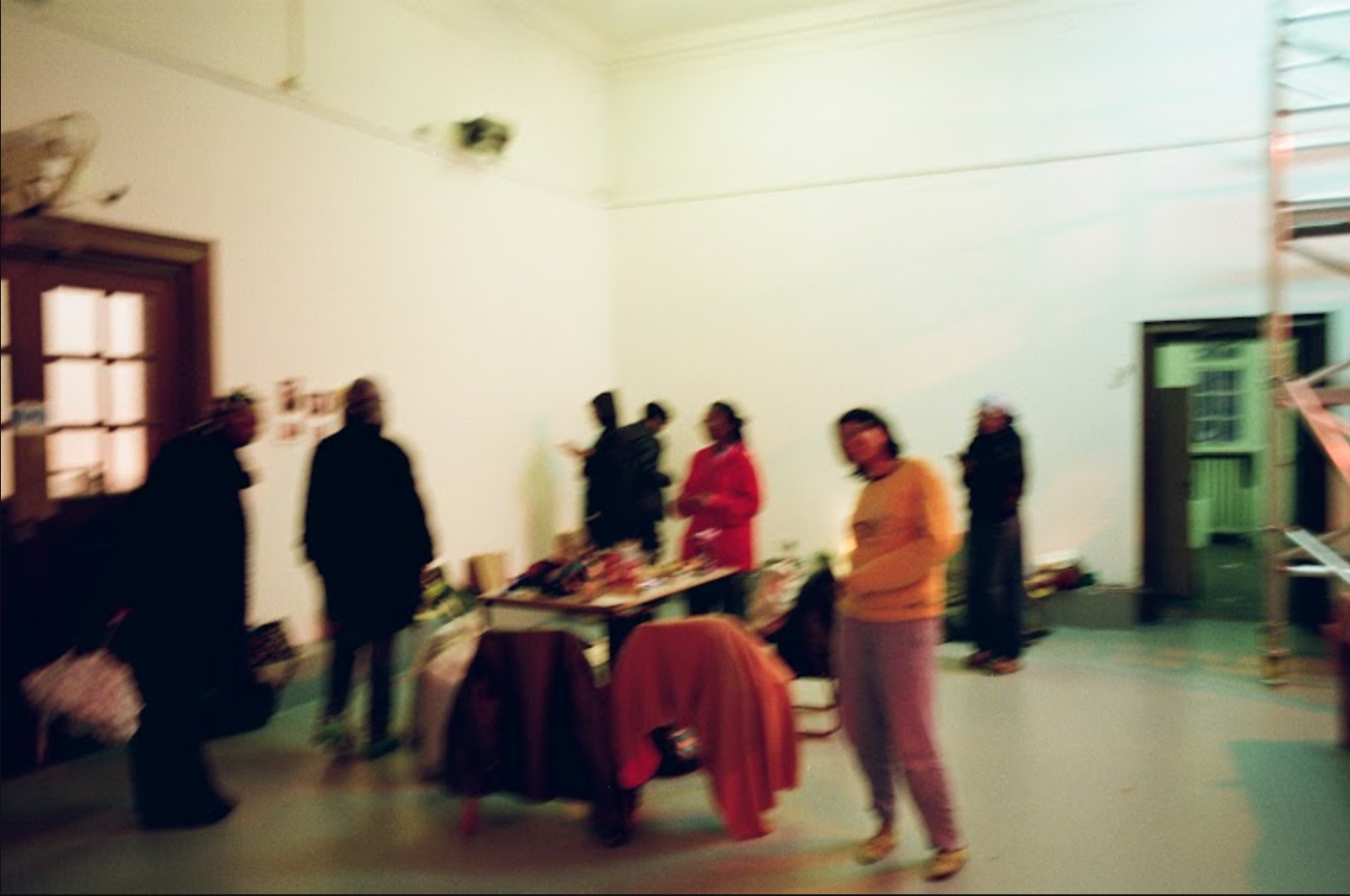
Playsure Networks exhibition installation, 35mm film, 2025
The principles underpinning 135 Home Studio are trust, commitment and presence, supported by collaboration, care, rest, patience, generosity and social responsibility. These are not simply values to be displayed in a manifesto; they must be enacted through the everyday organisation of the project.
Trust is developed through consistency and accountability. Commitment is demonstrated by returning to one another, maintaining relationships and accepting responsibility for shared work. Presence means giving time and attention to the people and processes that make collective practice possible.
These principles inform the practical decisions behind our programming: establishing safeguarding measures, building trust through regular critiques, addressing conflict, developing artists’ skills and drawing on existing networks of knowledge and support. They also inform how we approach collective curation.
The open call brought together thirteen artists whose practices and perspectives could contribute to the exhibition. Developing the project collectively meant negotiating different ideas, working through disagreements and managing the practical demands of producing an exhibition. Collective authorship did not remove questions of power. As founder and curator, I continued to hold responsibility for key decisions, including giving final approval. Acknowledging this asymmetry is important: collective practice does not automatically dissolve hierarchy, but it can create opportunities to make authority visible, negotiate its limits and distribute responsibility more thoughtfully. It also highlighted that leadership can and should be temporal. When other participants had more expertise on a part of the project they led it, not as department heads but as step-in directors, as if we were continually passing a baton.
The exhibition’s development required artists to contribute to shared tasks, from marketing and installation to the organisation of music and conversations around selling artwork. It also raised questions about remuneration, resources and what happens after an exhibition closes. These details are part of the curatorial method. They determine who can participate, whose labour is recognised and whether the relationships established through a project can continue beyond its immediate production.
135 Home Studio draws inspiration from African philosophies and traditions of collective responsibility, alongside Black radical thought, queer and feminist practice, and curatorial activism. The principle of Ubuntu foregrounds the relational dimensions of personhood and collective life. Our lived experience created the knowledge in which we used to bring forth artwork that added to what “[Susan Hardy] Aiken names as a polylogue (a term she borrows from philosopher, psychoanalysis, and literary critic Julia Kristiva): ‘an interplay of many voices, a kind of creative ‘barbarism’ that would disrupt the monological, colonizing, centristic drives of civilization’” (edits and redactions mine). As a group we created a relational approach to curating, which was interested in a multitude of voices speaking simultaneously, so that harmony was found and not forcibly created.2
These ideas do not provide a universal blueprint, nor do they eliminate the difficulties of working together. They offer points of orientation from which we can ask how trust, reciprocity and shared responsibility might shape new forms of cultural production.
For Home Studio, the task is to develop a complex set of practices capable of responding to complex problems. This includes learning from historical movements, seeking institutional and community support, paying artists, adapting to changing circumstances and resisting the pressure to become self-sufficient at the expense of collective survival. It also means allowing ourselves the right to play.
Conclusion: Towards Collective Freedom
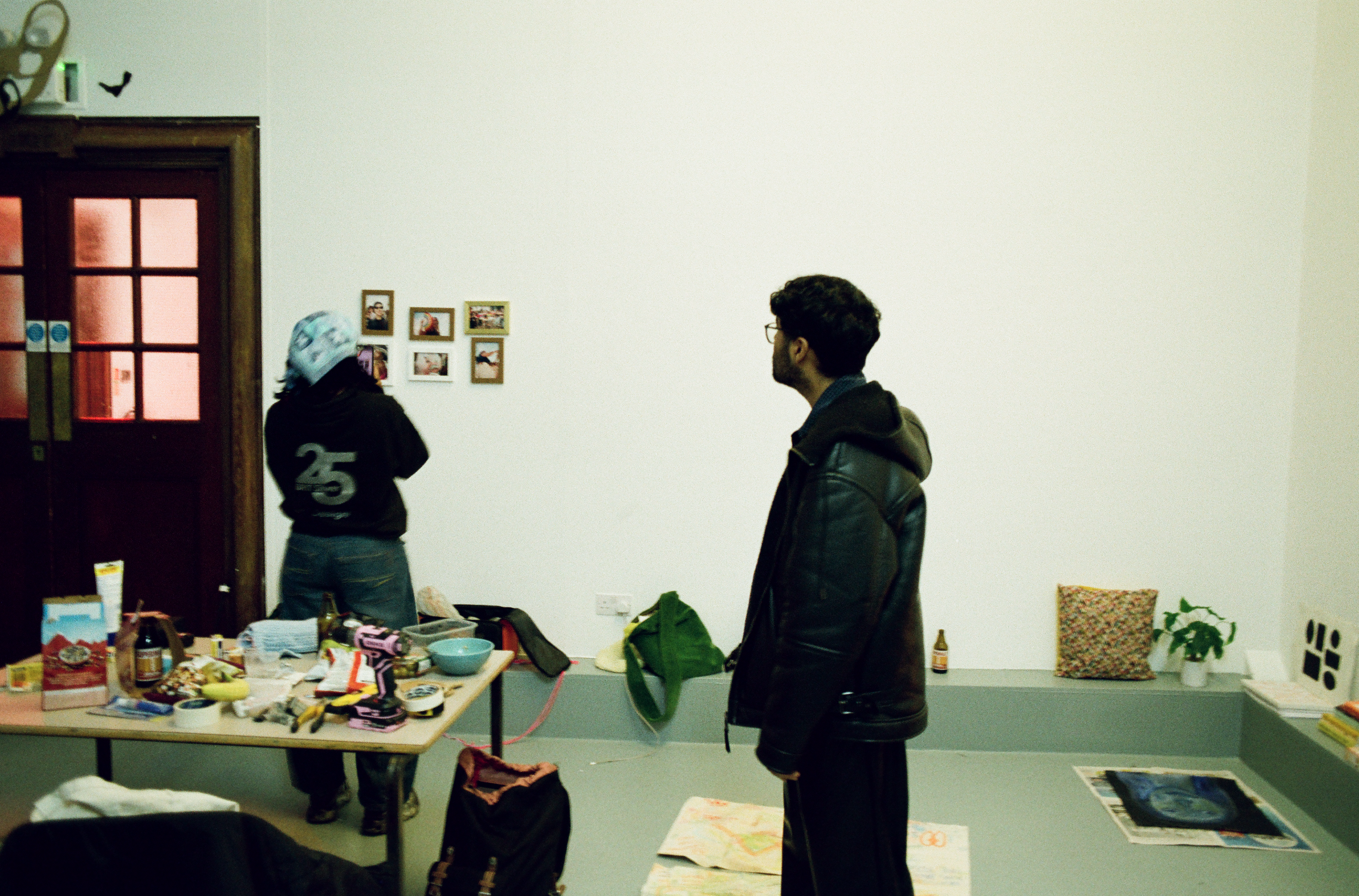
Playsure Networks exhibition installation, 35mm film, 2025
Playsure Network: Experiments Towards Resistance is not a claim that Home Studio has solved the problems it confronts. It is an invitation to consider what becomes possible when artists are given the time, space and relationships needed to develop their practices together. We have seen the ripple effects of our time together through long lasting friendships that provide all kinds of support including work opportunities.
The exhibition represents one stage in an ongoing experiment: a temporary gathering through which new connections can be made, existing relationships strengthened and alternative forms of cultural organisation tested. Its significance lies not only in the work presented, but also in the processes that made its presentation possible.
What would it mean to build cultural institutions that understand rest as necessary, care as infrastructure and relationships as a form of collective resource? How might we organise ourselves so that artistic freedom does not depend on individual sacrifice? And what kinds of political futures become imaginable when our methods of resistance make room for pleasure?
The crises we face are interconnected, and so must be the practices through which we respond to them. Friendship cannot replace housing, art cannot substitute for political organisation, and pleasure cannot erase structural violence. But relationships can help us recognise one another, share resources, develop strategies and sustain the capacity to act.
Perhaps the most urgent work is not simply to imagine a different future, but to begin practising its possibilities in the present. 135 Home Studio is one such practice: unfinished, sometimes difficult, and necessarily dependent on others. Its ambition is to create a space in which Black queer artists can do more than survive the conditions around them. It is to make room for the freedom to create, to care, to disagree, to rest and to experience pleasure together.
In an art world that continually asks us to compete, isolate ourselves and exhaust our capacities, choosing to build and maintain relationships can itself become an experiment in resistance. Playsure is an invitation to take that experiment seriously.
Members of AWITA
Maura Riley’s Curatorial Activism, p.30 cites Lucy R. Lippard, from the center, p.38
